
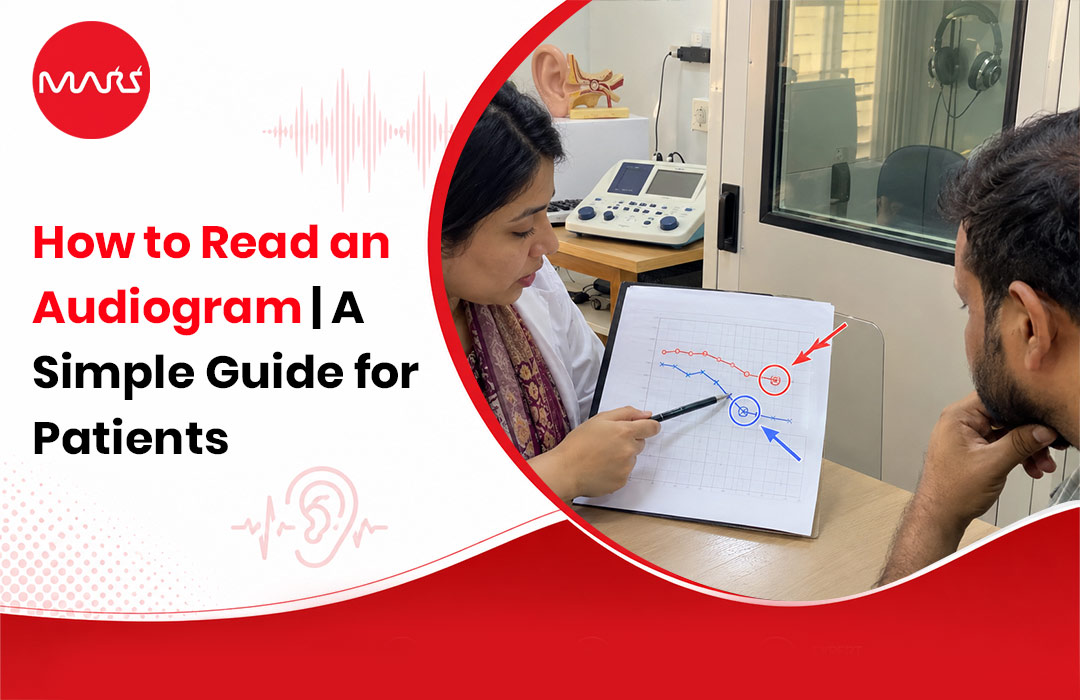
After a hearing test, the audiologist gives you a graph full of X’s, O’s and lines. Many people look at it and feel lost. Don’t worry. Once you know a few simple rules, it is easy to understand.
In this guide, you will learn how to read an audiogram step by step. We use simple words, so anyone in Bangladesh can follow along.
What Is an Audiogram?
An audiogram is a chart of your hearing. It shows the softest sounds you can hear at different pitches. It is made during a hearing test (also called audiometry). Each ear is tested separately, so you get one result for your right ear and one for your left ear.
An audiogram helps your audiologist find out:
- How much hearing loss you have
- Which sounds are hard for you to hear
- Where the problem is in your ear
- Whether hearing aids can help you
If you want to know what happens during the test, you can read more on the MARS Hearing & Health blog.
How to Read an Audiogram: The Two Sides of the Chart
Every audiogram has two lines (called axes). Learn these two, and you have done half the work.
1. Across the chart: Pitch (Frequency)
The horizontal line shows pitch. Pitch is how high or low a sound is. It is measured in Hertz (Hz).
- Left side (250–500 Hz): low sounds, like a drum or thunder
- Middle (1000–2000 Hz): the sounds of normal speech
- Right side (4000–8000 Hz): high sounds, like birds, a bell, or the letters “s,” “f,” and “th”
2. Up and down the chart: Loudness
The vertical line shows loudness. It is measured in decibels (dB).
- Top of the chart: very soft sounds
- Bottom of the chart: very loud sounds
Remember this one rule: the lower your marks are on the chart, the louder the sound needed to be before you could hear it. So lower marks mean more hearing loss.
What Do the Symbols Mean?
An audiogram uses simple symbols.
| Symbol | Meaning |
|---|---|
| O (red) | Right ear |
| X (blue) | Left ear |
| < or [ | Right ear, bone conduction |
| > or ] | Left ear, bone conduction |
The symbols are joined by a line. This line shows how your hearing changes from low sounds to high sounds.
Air conduction tests your full hearing path, from the outer ear to the inner ear. Bone conduction tests the inner ear directly. When your audiologist compares both, they can find the type of hearing loss.
Levels of Hearing Loss
Now look at where your marks are. This table will help you.
| Hearing Level | What It Is Called | What You May Notice |
|---|---|---|
| 0–25 dB | Normal hearing | No problem |
| 26–40 dB | Mild loss | Hard to hear soft voices or noisy places |
| 41–55 dB | Moderate loss | Hard to follow a normal talk, TV volume goes up |
| 56–70 dB | Moderately severe loss | People must speak loudly |
| 71–90 dB | Severe loss | Most speech is not heard |
| 91 dB and above | Profound loss | Very few sounds are heard |
Clinics may use slightly different numbers, so always ask your audiologist about your own result.
What Is the “Speech Banana”?
Some audiograms show a curved, shaded area. People call it the speech banana. It shows where the sounds of daily speech fall.
If your marks fall below the banana, you may miss some speech sounds. This is why many people say, “I can hear people talk, but I cannot understand the words.”
Three Types of Hearing Loss You Can See
Conductive Hearing Loss
Here, air conduction shows loss, but bone conduction looks normal. The problem is in the outer or middle ear. It can be caused by earwax, infection, or fluid. Many times, it can be treated by a doctor.
Sensorineural Hearing Loss
Here, both air and bone conduction show a similar loss. The problem is in the inner ear or hearing nerve. It is often caused by age, loud noise, or family history. It is usually permanent, but hearing aids can help a lot.
Mixed Hearing Loss
This is a mix of both types. There is a problem in the middle ear and the inner ear.
Common Shapes on an Audiogram
- Sloping loss: good hearing for low sounds, poor hearing for high sounds. This is the most common shape.
- Flat loss: the same loss at all pitches.
- Rising loss: poor hearing for low sounds.
- Noise notch: a sharp dip near 4000 Hz, often from loud noise.
- Different ears: if one ear is much worse than the other, you should see a specialist soon.
A Simple Way to Read Your Audiogram
- Find the red O (right ear) and the blue X (left ear).
- Look across the chart to see the pitch.
- Look up and down to see the loudness.
- Check how low your marks are. Lower means more loss.
- Compare your two ears.
- Look at bone conduction marks to find the type of loss.
- Ask your audiologist what the results mean for your daily life.
Other Tests You May Need
An audiogram is only one part of a full hearing check. Your audiologist may also do:
- Speech test: checks how well you understand words
- Tympanometry: checks how your middle ear is working
- OAE test: checks the health of your inner ear
What to Do After Your Audiogram
- Normal result: protect your ears from loud noise. Test again after 1–2 years.
- Hearing loss: talk to an audiologist about the best solution.
- Sudden hearing loss, ear pain, or one-sided loss: see a doctor or specialist right away.
Today’s hearing aids are small, smart and easy to use. Many come with rechargeable batteries, Bluetooth and AI technology. You can see our full range on the hearing aids page, with brands like NuEar, Starkey, Phonak and Rexton.
Get Your Audiogram Explained at MARS Hearing & Health
You can learn the basics from this guide. But a trained audiologist can tell you exactly what your audiogram means for you.
MARS Hearing & Health is the largest network of hearing care centers in Bangladesh. We are also the exclusive dealer of NuEar, Starkey, Phonak and Rexton hearing aids in the country. We believe everyone should hear well to live well, and we work to make hearing care easy to reach and affordable.
How we can help you:
- Read about us and our mission
- See all our hearing care services, including hearing tests and hearing aid fitting
- Find hearing aids and accessories for daily care
- Visit the nearest MARS branch
- Contact us to book your appointment
Frequently Asked Questions (FAQ)
How do I read an audiogram for beginners?
Look at the pitch (across) and the loudness (up and down). Red O is the right ear. Blue X is the left ear. The lower the marks, the more hearing loss.
What is a normal audiogram?
A normal audiogram shows hearing between 0 and 25 dB at all pitches, in both ears.
What do O and X mean on an audiogram?
O is the right ear. X is the left ear.
What is mild, moderate and severe hearing loss?
Mild is about 26–40 dB. Moderate is 41–55 dB. Moderately severe is 56–70 dB. Severe is 71–90 dB. Profound is 91 dB or more.
What is the speech banana?
It is the shaded area that shows where speech sounds fall on the chart.
Can I read my audiogram at home?
You can understand the basics, but only an audiologist can explain it fully.
What if my two ears are different?
This is called asymmetrical hearing loss. Please get it checked by a specialist.
Do I need hearing aids?
Many people with mild to profound hearing loss feel better with hearing aids. Your audiologist will guide you after a full check.
How often should I get an audiogram?
Test your hearing every 1–3 years, or sooner if you notice a change.
Where can I get an audiogram in Bangladesh?
You can visit any MARS Hearing & Health center. Check our branches page to find the closest one.
